
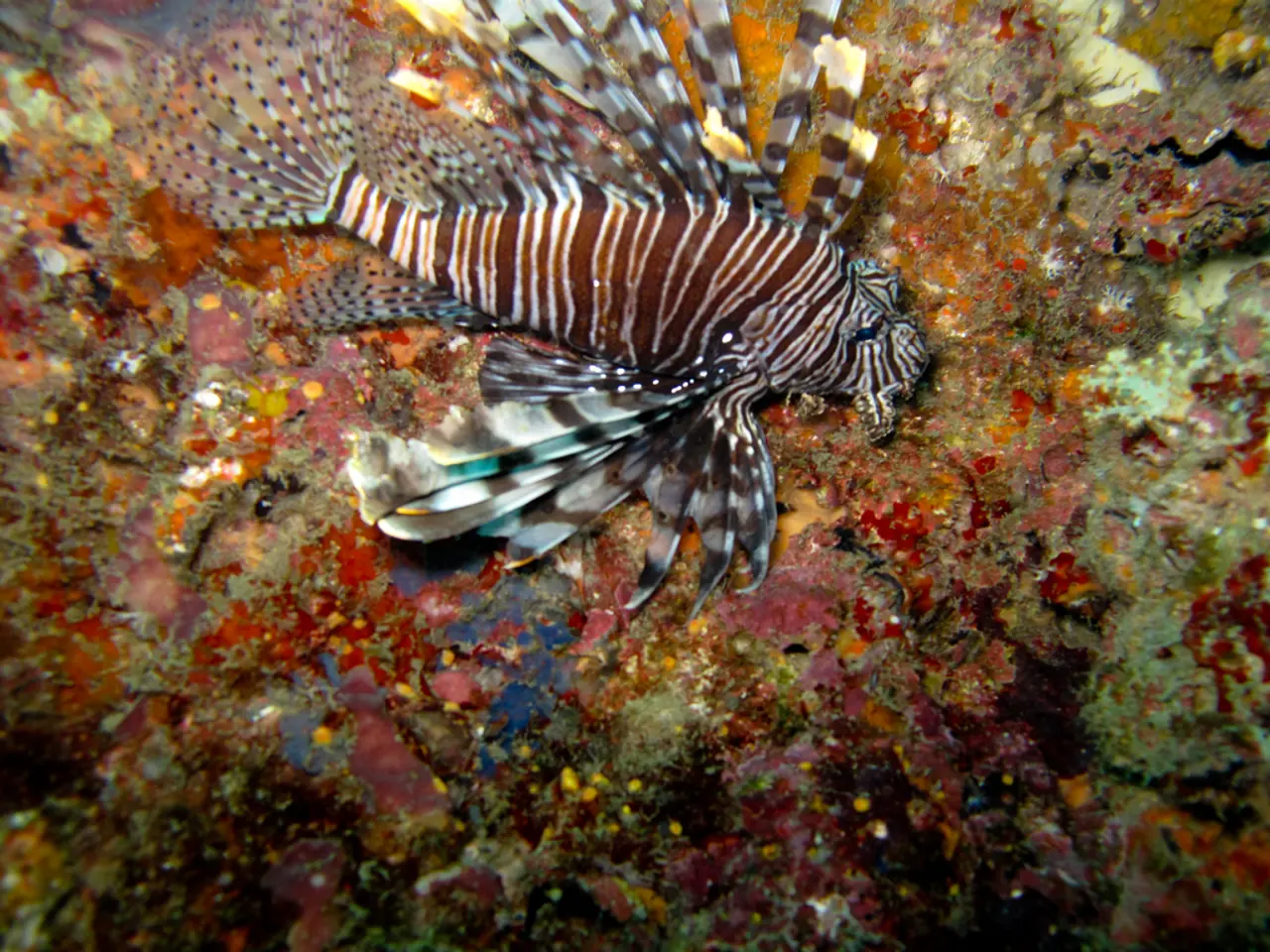
Fish's Hovering Status is Non-Relaxing
**New Study Unveils the Energy Costs of Fish Hovering**
In a groundbreaking study published in the Proceedings of the National Academy of Sciences, researchers have revealed that fish expend significantly more energy when hovering compared to resting, shedding light on the biomechanics of this intriguing aquatic behaviour.
The study, led by scientists at the University of California San Diego, involved 13 species of fish with swim bladders, and was co-authored by researchers from Stockholm University, Scripps Oceanography, the Max Planck Institute of Animal Behavior, the University of Konstanz, and Aberystwyth University in Wales.
The key findings suggest an evolutionary trade-off in fish body shapes, where increased maneuverability comes at the cost of hovering efficiency and vice versa.
One of the primary reasons for this energy expenditure is the separation of a fish's centers of mass and buoyancy. Fish with a greater separation between these two points tend to use more energy while hovering, as they need to counteract instability, which requires additional energy to maintain their position in the water column.
The shape of the fish and the position of its pectoral fins also play a significant role in hovering efficiency. Fish with pectoral fins farther back on their body are generally more efficient at hovering, likely due to improved leverage.
Hovering, it appears, is not a passive activity. It requires continuous adjustments to maintain stability, which is energetically costly due to the need for precise motor control. For fish that are not neutrally buoyant, generating lift to counteract gravity adds to the energetic cost of hovering.
The study found that hovering burns roughly twice as much energy as resting, contrary to previous assumptions. Activities like guarding nests, feeding in specific locations, or maintaining position in the water column are more demanding than previously thought.
The findings of this study could have far-reaching implications, particularly in the design of underwater robots or drones. By understanding the factors contributing to energy expenditure in fish hovering, researchers can develop more efficient underwater vehicles.
Designing robots with minimized separation between their centers of mass and buoyancy can reduce energy expenditure during stable operations. This could involve integrated buoyancy systems that adjust to maintain equilibrium. Incorporating propulsion systems that mimic the efficient leverage of fish fins, such as rear-mounted thrusters, could enhance energy efficiency during hovering or maneuvering.
Implementing advanced control systems that allow for precise and efficient adjustments to maintain stability can reduce energy consumption. This could involve sophisticated sensors and AI-driven control algorithms. Using lightweight and durable materials can help reduce the overall mass of the robot, potentially reducing the need for additional lift generation and thus lowering energy costs.
By incorporating these design principles, underwater robots or drones can be made more efficient and capable of performing tasks that require prolonged hovering or precise control, such as environmental monitoring, underwater exploration, or even assisting fish in aquaculture settings.
In conclusion, this study provides valuable insights into the energetics of fish hovering, shedding light on the complex interplay between body shape, fin position, and energy expenditure. These findings could pave the way for more efficient underwater vehicles and a deeper understanding of the adaptations that allow fish to thrive in their aquatic environments.
Science and oceanographic research have unveiled that hovering in fish is not a passive activity but requires significant energy, twice as much as resting, as revealed in a study led by scientists at the University of California San Diego. This energy expenditure can potentially be reduced in the design of underwater robots and drones, particularly through minimizing the separation between their centers of mass and buoyancy, adopting propulsion systems that mimic fish fins' efficient leverage, and incorporating advanced control systems to maintain stability efficiently. Such innovative designs could lead to more efficient underwater vehicles, benefiting fields like health-and-wellness, fitness-and-exercise, and environmental monitoring in aquatic environments.