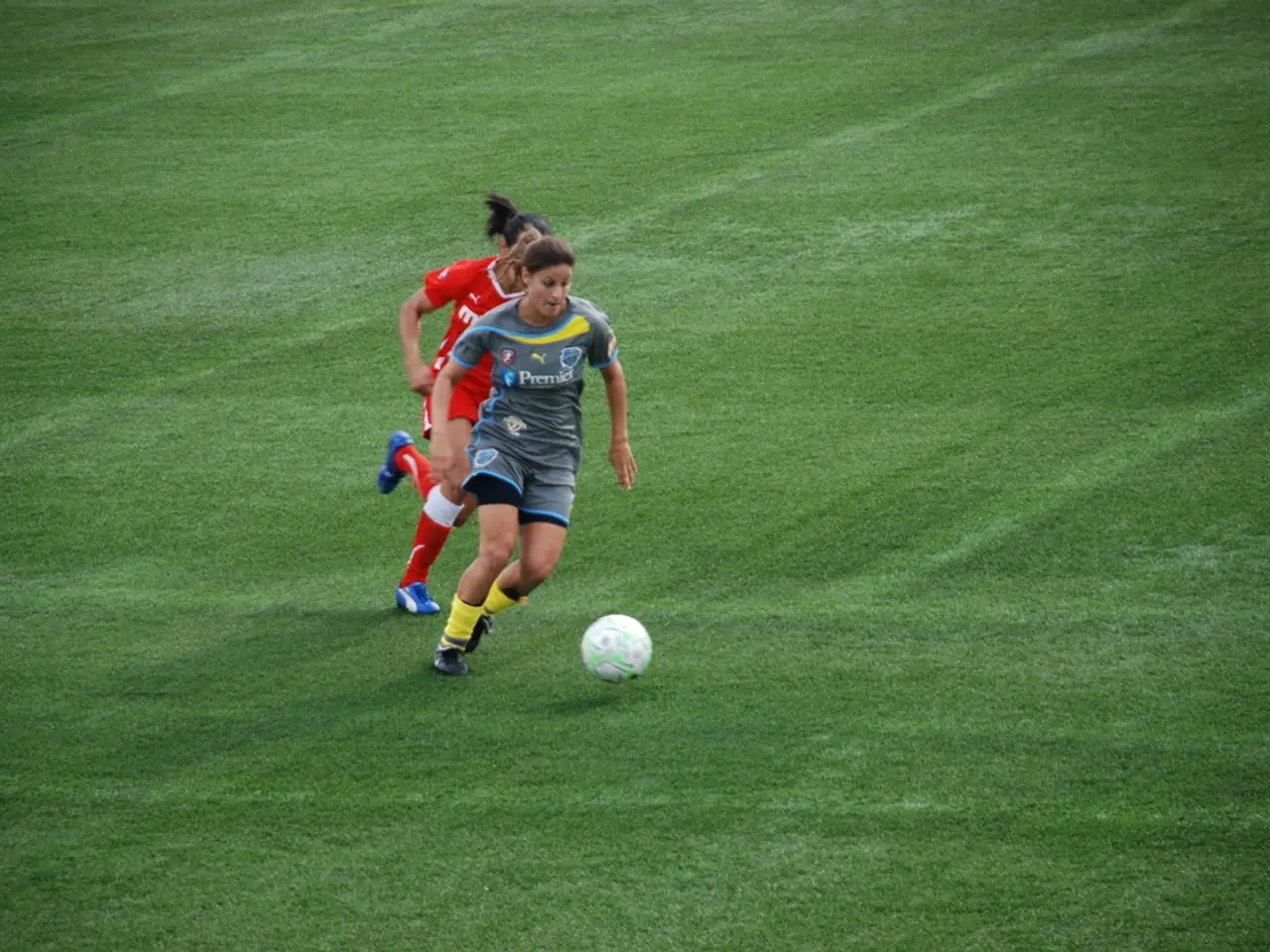
Football's highest ranks lack significant female representation, according to research findings
In the world of German football, a call for change echoes as the number of women in top management positions remains low. According to a survey conducted by the organization "Football Can Do More" (FKM), out of 100 leadership team positions in German top-tier and second-tier football clubs, only six will be held by women in the upcoming 2024/2025 season.
Alexander Wehrle, chairman of the board at VfB Stuttgart, acknowledged the current situation, stating that the club is not yet where they want to be in terms of gender representation in leadership roles. The lack of women in these positions is a concern that extends beyond Stuttgart, as the Bundesliga clubs, including top teams like Bayern Munich, Borussia Dortmund, and Bayer Leverkusen, are primarily discussed in terms of sporting achievements, attendance, and player information.
Axel Hellmann, board spokesman of Eintracht Frankfurt, has emphasised the need for more women in leadership positions in football. He believes that support and drive from club members and fans are crucial for achieving this goal. The sentiment is shared by Fernando Carro, managing director of Bayer Leverkusen, who highlighted the importance of diversity for their organisation and society as a whole.
Katja Kraus, co-chairwoman of the FKM board and the first woman to join the board of a football Bundesliga club, Hamburger SV, in 2003, has stated that positive discussions and efforts to change have not yet resulted in corresponding numbers. She clarified that the analysis is not a blame game, but football is a results-oriented sport, and the lack of women in leadership roles is a result that needs to be addressed.
Federal Research Minister Dorothee Bär (CSU) has also weighed in on the issue, stating that with 6 percent women in top management, Bundesliga clubs perform significantly worse than comparable small and medium-sized enterprises in Germany. This disparity is a call to action for the football industry to take steps towards improving gender representation in leadership roles.
The FKM survey is based on the AllBright reports, which analyze the composition of supervisory boards and management boards of DAX companies. The survey found that the top management in German football is typically male, German, around 50 years old, has an academic education, has held the current leadership position for 5.6 years, and has been working full-time at the club for 8.6 years. The proportion of international profiles among supervisory body members is 3.3 percent. Out of 271 positions in the supervisory bodies of the 36 clubs, 28 (10.3 percent) are held by women.
As the football industry continues to evolve, it is essential that gender representation in leadership roles is addressed. The call for more women in leadership positions in football is gaining momentum, and it is hoped that the 2024/2025 season will see a significant increase in the number of women in top management positions in Bundesliga clubs. Further specific research or direct inquiry with clubs or governing bodies (e.g., DFL - Deutsche Fußball Liga) would be needed for precise statistics.
- The call for more women in top management positions in football is not limited to VfB Stuttgart, as it also applies to other Bundesliga clubs, such as Bayern Munich, Borussia Dortmund, and Bayer Leverkusen.
- In a broader context, the lack of women in leadership positions in football parallels the situation in the business sector, where German football clubs perform poorly compared to small and medium-sized enterprises in terms of gender representation.
- Diversity and inclusion are not just important for individual organizations like Bayer Leverkusen, but for society as a whole, as emphasized by Fernando Carro.
- Champions of gender equality, like Katja Kraus, are advocating for a change in the health-and-wellness sector as well, encouraging the promotion of women's health and adding a new dimension to the conversation about science, business, and sports.