
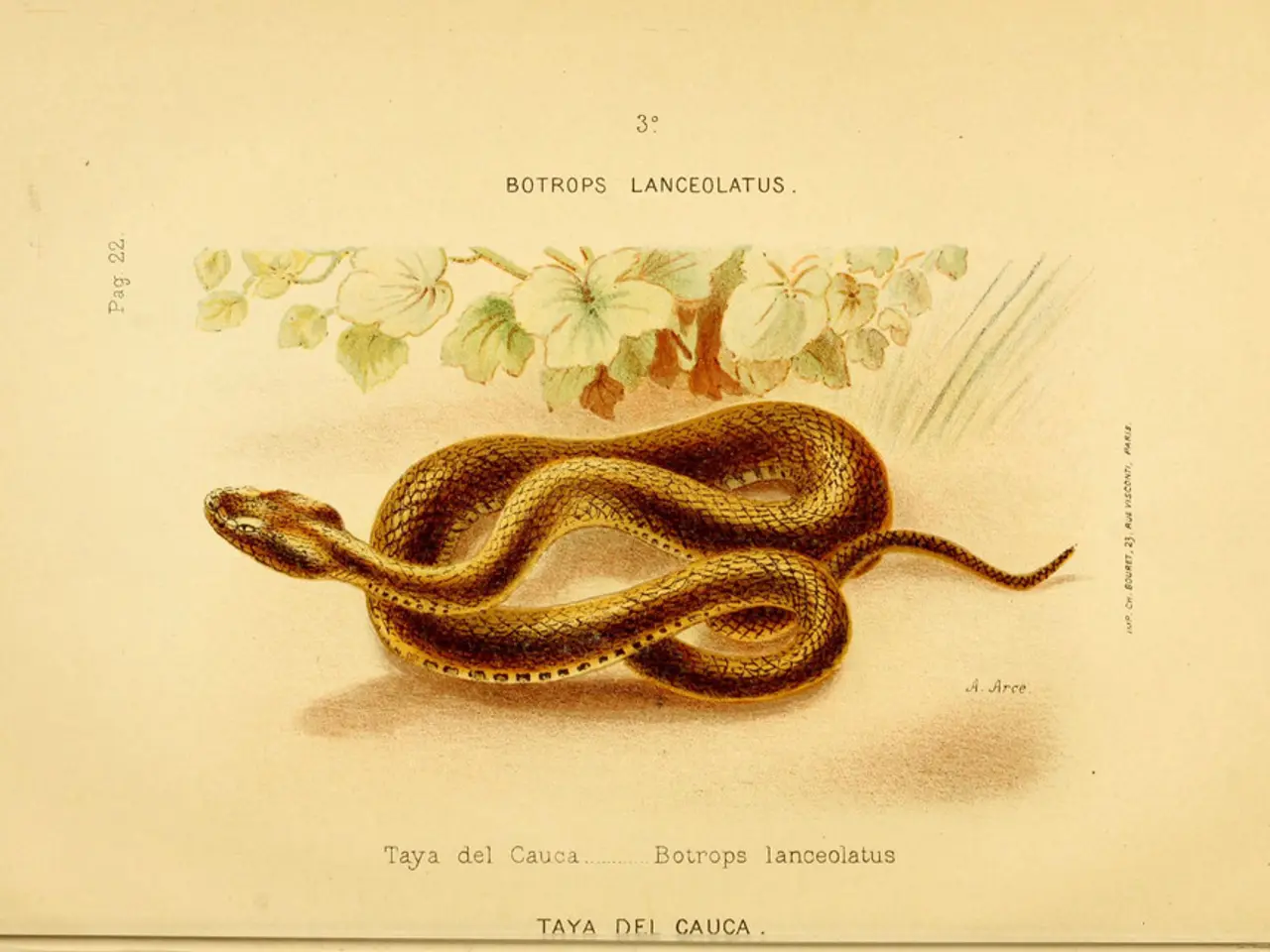
Native to Eastern North America, the Thamnophis sirtalis sirtalis, specifically referred to as the eastern garter snake, can be found.
In a groundbreaking study published in Behavioral Ecology and Sociobiology, research led by Morgan Skinner, a doctoral candidate in behavioral ecology at Wilfrid Laurier University in Canada, has shed light on the social lives of eastern garter snakes.
The study involved 40 juvenile eastern garter snakes, a mix of males and females, housed in a walled, tabletop enclosure with four plastic shelters. Each snake was marked with a unique pattern of nontoxic colored dots on its head for identification. The scientists tested the snakes' personalities, categorizing them as either "shy" or "bold."
Contrary to popular belief, the study suggests that garter snakes have more social intelligence and a larger social repertoire than previously realized. The snakes returned to their original groups of three to eight individuals inside the small shelters, showing a preference for specific snakes they had previously socialized with. This behavior, reminiscent of human friendships, is now increasingly being observed in various animal species, including flamingos, bats, and elephants.
The experiment was conducted in captivity, and its results may not fully translate to natural conditions. However, the study's findings align with observations of wild garter snakes, who form aggregations similar to those they created in the lab. These aggregations serve important biological functions, ensuring reproductive opportunities and survival through communal hibernation.
Snake friends usually curl up together, which helps them retain heat and defend against predators. Interestingly, friendships in garter snakes are not related to reproduction or mating. In groups, personality differences between snakes vanished, and they generally followed the herd.
Outside of mating and denning, garter snakes are predominantly solitary. They focus on activities like thermoregulation and foraging. However, during denning and mating seasons, social interactions allow them to efficiently mate by taking advantage of the females’ receptive state immediately after emerging from hibernation. This increases the likelihood of successful reproduction through courtship behaviors and mating rituals. The social benefits include better mating success and protection during communal denning, especially over cold seasons when temperatures drop.
This pattern is consistent with snake behavior globally, where social interactions are brief and functional rather than sustained or complex social relationships. The field of studying social networks in wildlife, such as snakes, has made significant advancements in the last few decades, opening up new avenues for understanding the intricate social lives of various species.
[1] Krause, J., & Ruxton, G. D. (2002). The costs of eavesdropping: a comparative analysis of the evolution of acoustic signals in animal communication. Trends in Ecology & Evolution, 17(10), 521-527.
[3] Dugatkin, L. A. (2000). The evolution of communication: an introduction. Oxford University Press.
- The study on eastern garter snakes will likely influence the field of ecology and sociobiology, shedding light on the social intelligence and repertoire of more wildlife species.
- Researchers in the health-and-wellness and fitness-and-exercise community might find the garter snakes' behavior reminiscent of human friendships interesting, particularly as it pertains to social bonds and group dynamics.
- Social media platforms, being an essential tool for entertainment and information dissemination, could be instrumental in raising awareness about the complex social lives of species like garter snakes, fostering a greater appreciation for nature and wildlife.
- Scientists in the realm of behavioral ecology, inspired by the findings on garter snakes, may further explore the social networks in other forest creatures, contributing to a deeper understanding of animal behavior and specie ecology.
- Outdoor enthusiasts and explorers, intrigued by the intricate social interactions of garter snakes, could potentially utilize this understanding to have more meaningful wildlife encounters during their adventures in forests and wilderness areas.
- The recent advances in understanding the social networks of wildlife, such as garter snakes, may spark curiosity among researchers in diverse fields, encouraging collaboration between science, entertainment, and social media for future projects investigating the social lives of numerous wildlife species.